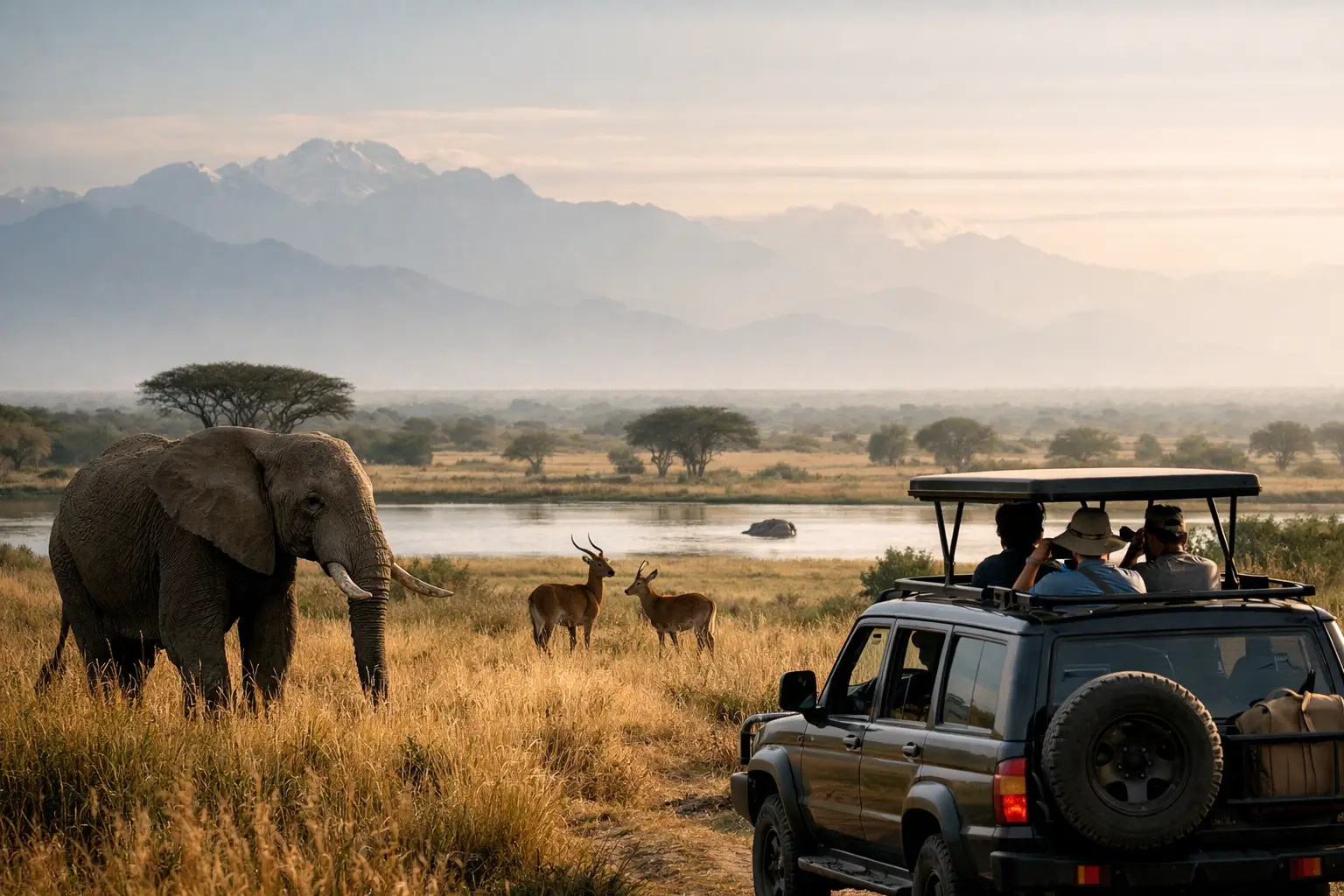
A herd of elephants crossing a crater rim road at golden hour tends to settle the question quickly. Queen Elizabeth National Park is one of those rare safari landscapes that feels expansive and intimate at the same time – a place where classic big-game viewing, volcanic scenery, and water-based wildlife experiences all come together in a single, beautifully varied journey.
For travelers considering Uganda, this is often the park that turns curiosity into commitment. It delivers variety in a way few safari destinations do. You can move from open savanna to papyrus-fringed channels, from crater lakes to fig trees where lions occasionally lounge above the ground, and from morning game drives to sunset boat excursions without the trip ever feeling rushed or repetitive. For a well-planned East Africa itinerary, that range matters.
What makes Queen Elizabeth National Park special
Set in western Uganda between Lake George and Lake Edward, Queen Elizabeth National Park is the country’s most established and diverse savanna park. It is also one of the most rewarding additions to a broader Uganda safari because it combines strong wildlife viewing with scenery that feels distinctly different from the better-known plains of Kenya or Tanzania.
The park sits against the backdrop of the Rwenzori Mountains and includes rolling grasslands, wetlands, forests, volcanic cones, and a remarkable concentration of crater lakes. That ecological variety shapes the experience on the ground. Wildlife is not confined to one predictable habitat, and each region of the park has its own rhythm, species mix, and visual character.
For luxury travelers, the appeal is not only what you see but how the days can be designed. Queen Elizabeth works especially well for those who want a safari with texture – perhaps chimpanzee tracking in Kyambura Gorge, a private boat outing on the Kazinga Channel, and unhurried game drives balanced with time to enjoy a well-positioned lodge. It is a destination that rewards thoughtful pacing.
Wildlife in Queen Elizabeth National Park
If your idea of safari is built around nonstop predator sightings, it helps to set expectations correctly. Queen Elizabeth National Park is wildlife-rich, but it is not the Serengeti. The strength here is diversity rather than density alone. That distinction matters, especially for travelers investing in a bespoke East Africa trip and wanting the right match between destination and expectations.
You can expect strong chances of seeing elephants, buffalo, Uganda kob, waterbuck, warthog, and hippos, with crocodiles lining the banks in the right areas. Leopards are present, though sightings are never guaranteed. Lions are a major draw, particularly in the Ishasha sector, where the population is known for tree-climbing behavior. It is one of the few places in Africa where that sighting is a realistic possibility, though not an entitlement. Timing, luck, and guide quality all play a role.
Birdlife is another reason this park consistently impresses. With hundreds of recorded species, Queen Elizabeth appeals not just to dedicated birders but to anyone who appreciates how much energy and color avian life adds to a safari. Even travelers who arrive focused on mammals tend to remember the fish eagles, bee-eaters, kingfishers, and storks that animate the waterways and grasslands.
The Kazinga Channel is more than a scenic add-on
Many safari parks have a boat excursion because they should. The Kazinga Channel feels different because it is central to the experience. This natural channel links Lake George and Lake Edward and draws extraordinary concentrations of wildlife to the water’s edge.
A boat safari here offers a shift in perspective that complements the game-drive experience beautifully. From the water, you are close to hippo pods, large buffalo herds, elephants coming down to drink, and an almost constant stream of birdlife. The pace is gentler, the photography can be exceptional, and the sense of immersion is striking.
For many travelers, it becomes the most memorable part of the park. That is especially true for multigenerational families or couples who want a safari rhythm that includes moments of stillness as well as action. A well-timed late-afternoon cruise can feel polished, cinematic, and deeply relaxing all at once.
Where to focus your time in the park
Queen Elizabeth is not a one-zone destination, and that is part of the reason expert itinerary design matters. Different sectors create very different safari experiences.
The Mweya Peninsula is the classic base and often the most convenient for first-time visitors. It offers access to game-driving areas and the Kazinga Channel, which makes it ideal for travelers who want variety without constant moving. The landscapes here are broad and open, and the logistics are generally straightforward.
Ishasha, in the southern sector, is where many travelers go in hopes of seeing tree-climbing lions. It has a more remote feel and pairs particularly well with a gorilla trekking itinerary in Bwindi, since it can create a logical route through southwestern Uganda. If tree-climbing lions are high on your wish list, spending time here is usually worthwhile. If they are simply a bonus, it may be better to weigh the extra driving against your overall trip pace.
Kyambura Gorge adds another dimension. This dramatic forested ravine is known for chimpanzee tracking, and while sightings can be less predictable than in some other Ugandan primate destinations, the setting is extraordinary. It is best approached as an enriching complement to a broader safari rather than the sole reason to visit the park.
When to visit Queen Elizabeth National Park
Uganda is a year-round destination, but conditions do shift. The drier months, generally from December through February and June through September, are often preferred for game viewing and road conditions. Wildlife can be easier to spot when vegetation is less dense, and transfers tend to be smoother.
That said, shoulder and green seasons have their own appeal. The landscapes are lush, birding is excellent, and there can be a softer, more exclusive feel to the experience. For photographers, the greener months can be especially rewarding. The trade-off is that rain may affect road conditions and make some game viewing less straightforward.
This is one of those destinations where the best time depends on the kind of safari you want. If your itinerary also includes gorilla trekking, chimpanzees, or other East African parks, the ideal dates often come down to balancing multiple experiences rather than optimizing for one park alone.
Is Queen Elizabeth National Park right for a luxury safari?
Absolutely – if luxury, for you, means thoughtful access, beautiful settings, strong guiding, and a journey designed around your interests rather than a one-size-fits-all circuit. This park is particularly well suited to travelers who value variety and want Uganda to feel more layered than a gorilla-trekking add-on.
The luxury proposition here is not about excess. It is about being in the right part of the park, with the right guide, enough time, and accommodations that frame the landscape rather than compete with it. In practice, that can mean waking to views over the savanna, returning from a private drive to a well-prepared dinner, or pairing a classic game-viewing day with a scenic flight that minimizes overland travel.
For couples planning a milestone trip, families wanting a softer safari rhythm, or seasoned Africa travelers looking beyond the usual headline parks, Queen Elizabeth often exceeds expectations. It feels wild, but not inaccessible. It feels iconic, but not overrun.
How Queen Elizabeth fits into a wider Uganda itinerary
The strongest Uganda itineraries rarely treat this park in isolation. Queen Elizabeth National Park works best as part of a carefully sequenced journey, often alongside Bwindi Impenetrable Forest, Kibale, or other western Uganda highlights.
That combination is what makes Uganda so compelling in the luxury space. You are not choosing between primates and classic safari landscapes. You can have both, and in a relatively compact geographic area. A few days in Queen Elizabeth can provide the open-country contrast that gives gorilla trekking itineraries more breadth and emotional range.
For some travelers, a fly-in approach is the best use of time. For others, a road-based journey works beautifully, particularly when scenic transitions are part of the appeal. It depends on your tolerance for driving, your preferred accommodation style, and how much of Uganda you want to experience at ground level. This is exactly where bespoke planning earns its value.
If Uganda is on your shortlist, Queen Elizabeth deserves serious attention. It is not simply a stop between other headline experiences. It is a park with its own identity, best appreciated by travelers who understand that a remarkable safari is not only about checking species off a list, but about how each day unfolds, how the landscape changes around you, and how expertly the journey has been put together. Done well, Queen Elizabeth National Park adds depth, grace, and a distinctly Ugandan sense of place to the entire safari.